
A review from someone who once scheduled a “playdate” for their toddler and then spent two hours engineering activities, narrating emotions, and wondering why parenting felt like a second full-time job
You’re exhausted. Not just tired—fundamentally depleted by the sheer intensity of modern parenting.
You spend your days negotiating, entertaining, stimulating, praising, redirecting, managing big feelings, and curating enrichment experiences. You’ve read the books about emotional coaching and growth mindset and gentle discipline. You’re doing everything “right.”
And yet your child whines constantly. Refuses to help around the house. Can’t entertain themselves for ten minutes. Has meltdowns over minor disappointments. Seems simultaneously overstimulated and perpetually bored.
Meanwhile, you’ve seen videos of children in other cultures—calmly helping their families, playing independently for hours, emotionally regulated in ways that seem almost impossible. And you’ve wondered: What do they know that we don’t?
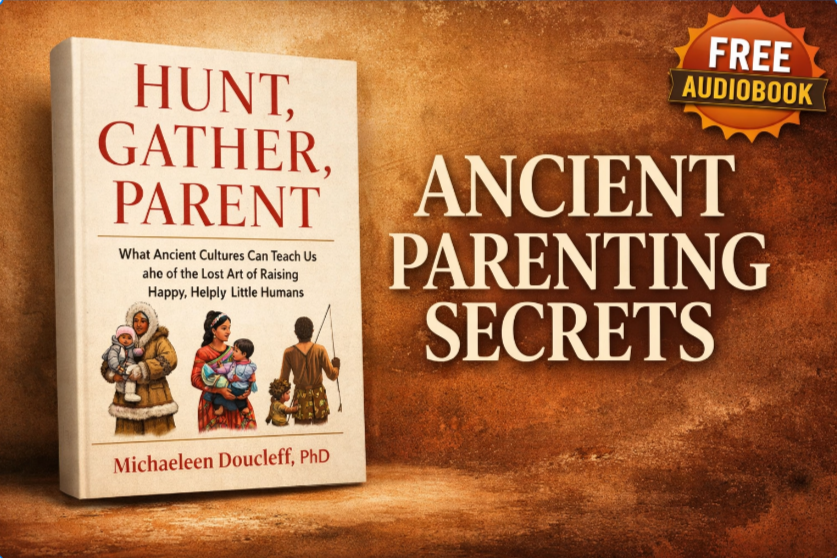
Michaeleen Doucleff wondered the same thing. So she took her tantrum-prone three-year-old and traveled to Maya villages in Mexico, Inuit communities in the Arctic, and Hadzabe camps in Tanzania to find out.
Hunt, Gather, Parent is her report from the field—a challenge to nearly everything Western parenting culture holds sacred. But is it genuinely revolutionary wisdom? Or romanticized anthropology that can’t survive translation to your actual life? Let’s examine what resonates, what falls short, and whether ancient parenting practices can help modern families.
What Is This Book? 🤔
Hunt, Gather, Parent documents Doucleff’s immersive experiences with three indigenous communities:
- Maya families in the Yucatán Peninsula — Learning about helpfulness and cooperation
- Inuit families in the Canadian Arctic — Learning about emotional regulation and calm discipline
- Hadzabe families in Tanzania — Learning about autonomy and child confidence
From these experiences, she extracts a framework she calls TEAM:
- Togetherness — Including children in adult life rather than separating into “kid world”
- Encouragement — Motivating through belonging and contribution, not praise and rewards
- Autonomy — Trusting children with real responsibility and freedom
- Minimal interference — Stepping back from constant managing and directing
The book argues that Western parenting has become pathologically child-centric, creating exhausted parents and incapable children. The solution isn’t better techniques—it’s a fundamental philosophical shift.
The book covers:
- Why Western parenting developed its peculiar intensity
- How Maya children become enthusiastic helpers
- How Inuit parents raise remarkably calm, emotionally regulated children
- How Hadzabe children develop confidence and autonomy
- Specific practices to implement in Western contexts
- The author’s own transformation and her daughter Rosy’s changes
- The science supporting indigenous approaches
It’s part travel memoir, part parenting manual, part cultural critique. 📖
The Good Stuff ✅
The “Include, Don’t Exclude” Paradigm Shift Is Profound
The book’s central insight challenges everything:
The Western model:
- Children live in “kid world” (playrooms, playgrounds, playdates)
- Adults live in “adult world” (work, chores, errands)
- These worlds are kept separate
- Parents visit kid world to entertain, then escape to adult world to get things done
- Children are excluded from adult activities because they “can’t help” or will “slow things down”
The indigenous model:
- Children are included in adult life from infancy
- There is no separate “kid world”
- Children participate in real work alongside adults
- Contribution is expected, not optional
- Children learn by watching and gradually doing
The consequence of Western exclusion:
- Children never learn to contribute because they’re never invited
- Parents are exhausted from maintaining two separate worlds
- Children feel purposeless and act out
- Helping feels like a special favor, not a normal expectation
- Kids are bored because kid world is actually boring
The consequence of indigenous inclusion:
- Children learn skills naturally through participation
- Helping becomes identity, not chore
- Parents aren’t separately entertaining children
- Children feel valued and purposeful
- The family operates as a unit, not competing factions
The practical shift:
Stop asking, “How do I entertain my child while I do this task?”
Start asking, “How can my child participate in this task with me?”
This reframe changes everything about daily life. 🎯
The Maya “Acomedido” Concept Is Transformative
Doucleff’s time with Maya families introduces a powerful idea:
Acomedido (ah-ko-meh-DEE-do):
A person who is aware of others’ needs and takes initiative to help without being asked.
Not just “helpful”:
- Helpful: Does what you ask
- Acomedido: Notices what needs doing and does it
How Maya children develop acomedido:
Early inclusion: Toddlers are welcomed into tasks, not shooed away. A two-year-old “helping” make tortillas is learning, not hindering.
Minimal correction: Adults don’t fix children’s contributions or take over. Imperfect help is still help.
No forcing: Children aren’t commanded to help. They’re invited. If they decline, that’s respected—but they’re invited again tomorrow.
Real consequences: If the child doesn’t help, the work doesn’t get done. There’s no parent swooping in to complete it.
Group identity: Helping is framed as “what our family does,” not as an individual achievement deserving praise.
The Western mistake:
We exclude toddlers from helping (“You’ll make a mess”), then demand help from older children (“Why won’t you ever help?”), then wonder why they resist.
The Maya wisdom:
The window for developing acomedido is early childhood. If you include them at two, you have a helper at twelve. If you exclude them at two, you have a battle at twelve.
This concept alone is worth the book. ✨
The Inuit Emotional Regulation Approach Is Revolutionary
Doucleff’s time in the Arctic reveals a radically different approach to children’s emotions:
The Western approach to tantrums:
- Emotional coaching (“I see you’re feeling frustrated…”)
- Immediate attention to the emotion
- Helping the child process in the moment
- Often inadvertently reinforcing the behavior through attention
- Parent matches child’s emotional intensity
The Inuit approach:
- Remain completely calm
- Don’t engage with the tantrum
- Don’t punish or lecture
- Wait until the child is calm (even hours or days later)
- Then address the behavior through story or play
- Model the regulation you want to see
The key insight:
Emotions are contagious. If you meet a child’s dysregulation with your own intensity (even “helpful” intensity), you escalate rather than calm.
The Inuit mantra:
“Never shout at children. It’s like hitting them.”
Why calm works:
- Children learn regulation by experiencing it from adults
- Attention during tantrums reinforces tantrums
- Emotional storms pass faster without an audience
- The teaching happens later, when the child can actually hear
The Western fear:
“But if I don’t respond immediately, won’t they think I don’t care?”
The Inuit answer:
Responding calmly IS caring. Matching their chaos isn’t helping—it’s drowning together.
The practical technique:
When your child is melting down, imagine you’re a glacier. Cold, calm, immovable, eternal. Be the glacier.
This approach produces the remarkably calm Inuit children Doucleff observed. 💪
The Critique of Praise Culture Is Evidence-Based
The book challenges Western praise habits:
The Western praise model:
- “Good job!” for everything
- Constant verbal affirmation
- Celebrating every small accomplishment
- Believing praise builds self-esteem
- Praising effort to encourage growth mindset
The indigenous alternative:
- Minimal verbal praise
- Acknowledgment through inclusion, not words
- Value communicated through trust, not compliments
- Contribution is expected, not celebrated
- Self-esteem comes from capability, not affirmation
Why excessive praise backfires:
It’s controlling: Praise is a form of evaluation. Constant evaluation creates performance anxiety.
It diminishes intrinsic motivation: Children start working for the praise, not the satisfaction.
It creates praise dependence: Children need external validation to feel good.
It’s often insincere: Children detect empty praise and learn to distrust it.
It emphasizes the individual: Praising individual achievement undermines collective contribution.
The alternative to praise:
Acknowledgment: “You did it.” (Not: “Good job!”)
Inclusion: Letting them contribute to meaningful work
Trust: Giving them real responsibility
Belonging: “This is what our family does together”
Consequences: Their contribution matters to real outcomes
The research:
This aligns with substantial psychological research on intrinsic motivation (see Alfie Kohn, Edward Deci).
Stop cheerleading. Start including. 🌟
The Autonomy Chapter Provides Permission to Step Back
Doucleff’s time with the Hadzabe reveals extreme child autonomy:
What she observed:
- Children as young as three roaming freely
- Kids handling knives and fire
- Minimal adult supervision
- Children solving their own conflicts
- Adults trusting children’s judgment
The Western contrast:
- Constant supervision
- Danger prevention at all costs
- Adult-mediated conflict resolution
- Assumption that children can’t handle risk
- Childhood as a protected bubble
The cost of Western overprotection:
- Children don’t develop risk assessment skills
- Confidence doesn’t develop without challenge
- Problem-solving atrophies without practice
- Children become anxious because they sense they can’t handle things
- Parents are exhausted from constant vigilance
The indigenous wisdom:
Children are far more capable than we assume. They need challenge, struggle, and even some danger to develop competence and confidence.
The practical applications:
- Let children use real tools (appropriately)
- Allow independent play without constant supervision
- Stop solving their peer conflicts
- Trust them with increasing responsibility
- Let them experience natural consequences of their choices
The balance:
This isn’t neglect—it’s calibrated trust. You assess the risk, prepare the child, then step back.
For helicopter parents, this is liberation. 🧠
The “Stop Entertaining” Permission Is a Relief
A consistent theme across cultures:
The Western expectation:
- Parents should play with their children
- Children need stimulation and engagement
- Boredom is a problem parents should solve
- Good parents create enriching activities
- Child-centered play is essential
The indigenous reality:
- Adults rarely play with children
- Children play with other children (multi-age groups)
- Children entertain themselves
- Adults work; children are nearby but not entertained
- Boredom is solved by the child, not the parent
The Western trap:
We’ve made ourselves our children’s primary entertainment. This is:
- Exhausting for parents
- Developmentally limiting for children
- Historically unprecedented
- Practically unsustainable
The permission:
You don’t have to play with your kids constantly. You don’t have to fill every moment with enrichment. You don’t have to be their entertainment director.
What to do instead:
- Include them in your tasks
- Let them be bored (boredom breeds creativity)
- Facilitate play with other children
- Be present but not directing
- Model adult activities they can observe
The relief:
You can fold laundry while they play nearby. You can cook dinner while they “help” or play independently. You can exist in adult mode while they exist in child mode, in the same space.
Parenting is not a performance. 📝
The TEAM Framework Is Memorable and Practical
Doucleff synthesizes her observations into an actionable system:
T — Togetherness:
- Include children in adult activities
- Work side by side
- Minimize separate “kid world”
- Family as a cooperative unit
E — Encouragement:
- Motivate through belonging, not praise
- “This is what our family does”
- Trust communicates value
- Contribution builds identity
A — Autonomy:
- Trust children with real responsibility
- Step back from constant supervision
- Allow natural consequences
- Let them solve their own problems
M — Minimal Interference:
- Don’t control every moment
- Don’t correct every mistake
- Don’t mediate every conflict
- Don’t entertain constantly
Why the framework works:
It’s easy to remember and apply. When facing a parenting moment, you can ask: Am I being a TEAM parent right now?
The test questions:
- Am I including or excluding? (Togetherness)
- Am I trusting or praising? (Encouragement)
- Am I stepping back or hovering? (Autonomy)
- Am I letting them figure it out or managing? (Minimal interference)
A simple framework for daily decisions. 🎓
The Science Integration Is Solid
Unlike purely anecdotal books, Doucleff includes research:
On helpfulness:
Studies showing that toddlers have an innate desire to help, which is often suppressed by exclusion and over-correction.
On praise:
Research on how extrinsic rewards undermine intrinsic motivation (Deci & Ryan’s Self-Determination Theory).
On emotional regulation:
Studies on co-regulation and how parental calm facilitates child calm.
On autonomy:
Research on how age-appropriate risk-taking builds resilience and confidence.
On play:
Studies showing that unstructured, child-directed play is more developmentally beneficial than adult-directed activities.
The value:
For skeptical readers, the science validates the cross-cultural observations. It’s not just “those people do it this way”—there are reasons it works.
The book bridges anthropology and psychology effectively. 🔬
The Not-So-Good Stuff 😬
The Romanticization Is Real
The book sometimes idealizes indigenous cultures:
The rosy picture:
- Children are always helpful
- Parents are always calm
- Communities are always supportive
- Life is simpler and better
What’s missing:
- Struggles and conflicts within these communities
- Children who don’t fit the cultural norms
- Historical trauma and contemporary challenges
- The difficulties and tradeoffs of these lifestyles
- Selection bias in what Doucleff observed
The concern:
When we romanticize other cultures, we:
- Flatten complex realities into simple lessons
- Ignore the less photogenic aspects
- Set up impossible comparisons
- Engage in a form of cultural tourism
The question:
Were Maya/Inuit/Hadzabe children always perfectly helpful and regulated? Or did Doucleff see what she was looking for?
The honest acknowledgment:
Every culture has struggling children, overwhelmed parents, and imperfect families. The book doesn’t adequately show this.
Wisdom from other cultures is valuable. Idealization is distorting. 🚩
The Structural Differences Are Underaddressed
What works in indigenous contexts depends on conditions that don’t exist in Western life:
Extended family:
- Indigenous children are raised by many adults
- Western children often have two parents (or one)
- The village that raises children doesn’t exist for most Western families
Community:
- Indigenous children have multi-age playmate groups readily available
- Western children often need scheduled playdates
- Spontaneous group play requires a density of children that suburbs lack
Work structure:
- Indigenous work happens at or near home
- Western work often requires separation from children
- Including children in work requires presence that many jobs don’t allow
Physical environment:
- Indigenous children have outdoor space to roam
- Many Western children live in apartments or unsafe neighborhoods
- Autonomy requires physical environments that support it
The gap:
Telling a single parent in a city apartment to “be like Maya families” ignores the structural impossibility of that advice.
What’s needed:
More attention to how principles (not just practices) can translate to radically different circumstances.
Context matters more than the book acknowledges. 😬
The Privilege Assumptions Are Significant
The book’s advice often assumes resources:
Time flexibility:
Including children in tasks takes longer. This requires time margin many families don’t have.
One parent available:
Much of the advice assumes someone is present with children during the day. Dual-income families or single parents face different realities.
Space:
A yard for free play, a kitchen big enough for child involvement, a neighborhood safe for roaming—these aren’t universal.
Support:
The indigenous model works with many adults. Implementing it alone is different.
Income:
Slower task completion, less structured childcare, and more presence all have economic implications.
The tension:
Doucleff is a successful author and NPR correspondent. Her ability to travel to three continents for parenting research reflects resources unavailable to many.
The gap:
How do you “include children in tasks” when the task is an eight-hour shift? How do you “let them roam” in an unsafe neighborhood?
More acknowledgment of structural constraints would strengthen the book. 💰
The Neurodivergent Gap Is Familiar
Like most parenting books, this one assumes neurotypical children:
For ADHD children:
- “Step back” may result in complete chaos
- Unstructured time may not lead to productive play
- Inclusion in tasks may require more scaffolding
- Natural consequences may not teach when impulsivity rules
For autistic children:
- Multi-age play groups may be overwhelming
- Unspoken social expectations may be inaccessible
- Sensory environments of “real work” may be dysregulating
- Autonomy needs may look different
For anxious children:
- Less supervision may increase anxiety, not confidence
- Unstructured time may create panic
- More support, not less, may be needed initially
The problem:
“All children have an innate desire to help” may be true, but the way that manifests varies enormously across neurotypes.
What’s missing:
Acknowledgment that these principles may need significant modification, or may not apply at all, for some children.
One-size-fits-all remains a persistent flaw. 🩺
The “Ancient Wisdom” Framing Is Problematic
The book sometimes implies indigenous = natural = better:
The troubling logic:
- These cultures have existed for thousands of years
- Therefore their parenting is “natural”
- Therefore it’s better than “modern” approaches
The problems:
- Longevity doesn’t prove optimality
- “Natural” isn’t a meaningful parenting criterion
- Indigenous cultures have also changed over time
- Survivorship bias affects which practices we observe
The missing complexity:
- What worked for subsistence survival may not be optimal for contemporary life
- Different goals require different approaches
- Indigenous cultures aren’t frozen in time—they adapt too
The nuance needed:
We can learn from other cultures without assuming they’ve discovered parenting truth that we’ve lost.
Wisdom and romanticization are different things. 🎭
The Adoption of Practices Without Context Is Risky
Cherry-picking practices from other cultures is tricky:
The risk:
Taking specific techniques without understanding the full cultural context in which they work.
Example: Autonomy
Hadzabe children have autonomy within a community where:
- Many adults are watching loosely
- The physical environment has been navigated for generations
- Older children guide younger ones
- Cultural knowledge is shared
Western children with the same “autonomy” may have:
- No supervising community
- Novel and changing environments
- No multi-age groups
- Less shared cultural knowledge
The potential for harm:
“They let their kids roam, so I will too” without the supporting structures could be dangerous.
What’s needed:
More explicit guidance on which principles translate vs. which practices require specific contexts.
Principles often transfer; practices often don’t. ⚠️
Screen Time and Modern Challenges Are Barely Addressed
The book focuses on timeless practices but misses contemporary realities:
What’s absent:
- How to handle screens and devices
- Video games and digital entertainment
- Social media (for older children)
- The attention economy’s assault on children
The irony:
The biggest obstacle to “minimal interference” and “unstructured play” is screens—and the book barely mentions them.
What’s needed:
How do indigenous-inspired principles apply to distinctly modern challenges? Can you be a TEAM parent when the “T” is interrupted by TikTok?
The gap:
Parents need guidance on the intersection of these principles with technology, not just pretending technology doesn’t exist.
A significant omission for contemporary applicability. 📱
The Memoir Elements Can Be Distracting
The book alternates between wisdom and personal narrative:
The structure:
- Doucleff’s struggles with her daughter Rosy
- Travel to indigenous communities
- Observations and lessons
- Application back to Rosy
- Repeat
The issue for some readers:
- Too much focus on the author’s personal journey
- Rosy’s tantrums become repetitive
- The transformation narrative can feel self-congratulatory
- Less interest in the author, more interest in the practices
The alternative preference:
Some readers would prefer a more direct presentation of principles without the memoir framing.
The counterargument:
Others find the personal narrative relatable and helpful for seeing how change happens.
Preference varies; know your own before starting. 📚
Who Is This For? 🎯
Perfect if you:
- Feel exhausted by the intensity of modern parenting
- Sense that something is fundamentally off about how we’re raising kids
- Have children who seem helpless, entitled, or constantly needing entertainment
- Are open to questioning Western parenting assumptions
- Want a philosophical shift, not just new techniques
- Have some flexibility in work and lifestyle to implement changes
- Find cross-cultural perspectives valuable
- Need permission to step back, include, and stop entertaining
Not ideal if you:
- Have neurodivergent children needing specialized approaches
- Face structural constraints (single parent, demanding work, unsafe neighborhood) that limit implementation
- Want research-validated techniques rather than anthropological observations
- Are skeptical of “ancient wisdom” framings
- Need specific guidance on modern challenges like screens
- Prefer direct advice to memoir-style narrative
- Are already practicing attachment parenting and find this too critical
- Live in circumstances very different from the book’s assumptions
Alternatives Worth Considering 🔄
Simplicity Parenting by Kim John Payne: Complementary philosophy about reducing overwhelm in childhood. Less cross-cultural, more directly applicable to Western contexts. 🏆
Free-Range Kids by Lenore Skenazy: Focuses specifically on the autonomy piece with practical advice for Western contexts. More directly addresses structural and legal constraints.
The Gardener and the Carpenter by Alison Gopnik: Developmental psychology perspective on why overparenting backfires. Better research foundation for similar conclusions.
The Self-Driven Child by William Stixrud & Ned Johnson: Autonomy-focused parenting with more attention to contemporary challenges and adolescence.
No-Drama Discipline by Daniel Siegel & Tina Payne Bryson: The emotional regulation piece with brain science foundation. More applicable for neurodivergent and trauma-impacted children.
Balanced and Barefoot by Angela Hanscom: Focuses on physical play and outdoor time. Practical complement to Hunt, Gather, Parent’s philosophy. 📚
The Final Verdict 🏅
Hunt, Gather, Parent offers a genuinely valuable challenge to modern parenting assumptions. The core insight—that we’ve made parenting too child-centric, too intensive, and too separate from real life—resonates with many exhausted families. The TEAM framework provides a memorable guide for recalibrating.
For parents drowning in the performance of modern parenthood, this book offers permission to stop. Stop entertaining. Stop hovering. Stop praising constantly. Stop maintaining separate child worlds. Start including, trusting, and stepping back.
However, the book’s limitations are real. The romanticization of indigenous cultures, the underacknowledged structural constraints, the neurodivergent gaps, and the absence of modern challenges (especially screens) all limit its applicability.
The useful parts:
- Include, don’t exclude: Paradigm shift with immediate application
- Acomedido concept: Understanding how helpfulness develops
- Inuit emotional regulation: The calm parent produces the calm child
- Praise critique: Evidence-based challenge to constant affirmation
- Autonomy emphasis: Permission to step back and trust
- TEAM framework: Memorable guide for daily decisions
- Science integration: Research validates the observations
The problematic parts:
- Romanticization: Indigenous cultures aren’t parenting utopias
- Structural blindness: Extended family, community, and environment matter
- Privilege assumptions: Time, space, and resources aren’t universal
- Neurodivergent gaps: Not all children fit these patterns
- Ancient wisdom framing: Longevity doesn’t prove optimality
- Screen silence: Biggest modern challenge barely addressed
- Memoir distractions: Personal narrative may not interest all readers
The best approach: Take the philosophy seriously while adapting for your specific context. You probably can include your children in more tasks. You probably can step back more. You probably can praise less and trust more. But how those principles translate to your actual life—with your specific children, circumstances, and constraints—requires your own creative adaptation.
The bottom line: Hunt, Gather, Parent is most valuable as a philosophical provocation. It challenges assumptions so deeply embedded in Western parenting that we don’t even see them as assumptions. That challenge is valuable regardless of whether you implement every practice.
The question isn’t whether you should parent exactly like Maya or Inuit or Hadzabe families. You can’t, and you probably shouldn’t try. The question is whether the intensity, separation, and child-centeredness of modern parenting is serving your family.
For most families, it isn’t. Something is exhausting parents and failing children simultaneously. Hunt, Gather, Parent offers one compelling diagnosis and direction, even if the specific prescription needs translation.
The permission to include your children in real life, to trust them with real responsibility, to stop performing parenthood, and to remain calm when they fall apart—that permission may be exactly what you need.
Not ancient wisdom. Not foreign practices. Just the reminder that children have always been capable of more than we assume, and parents have always been allowed to be less than we’ve been told.
That’s a message worth hearing. 🌍✨
Have you tried implementing any Hunt, Gather, Parent practices? What’s translated well to your family, and what hasn’t worked? How do you balance these principles with the realities of your specific life? Share your experiences below!
Leave a Reply